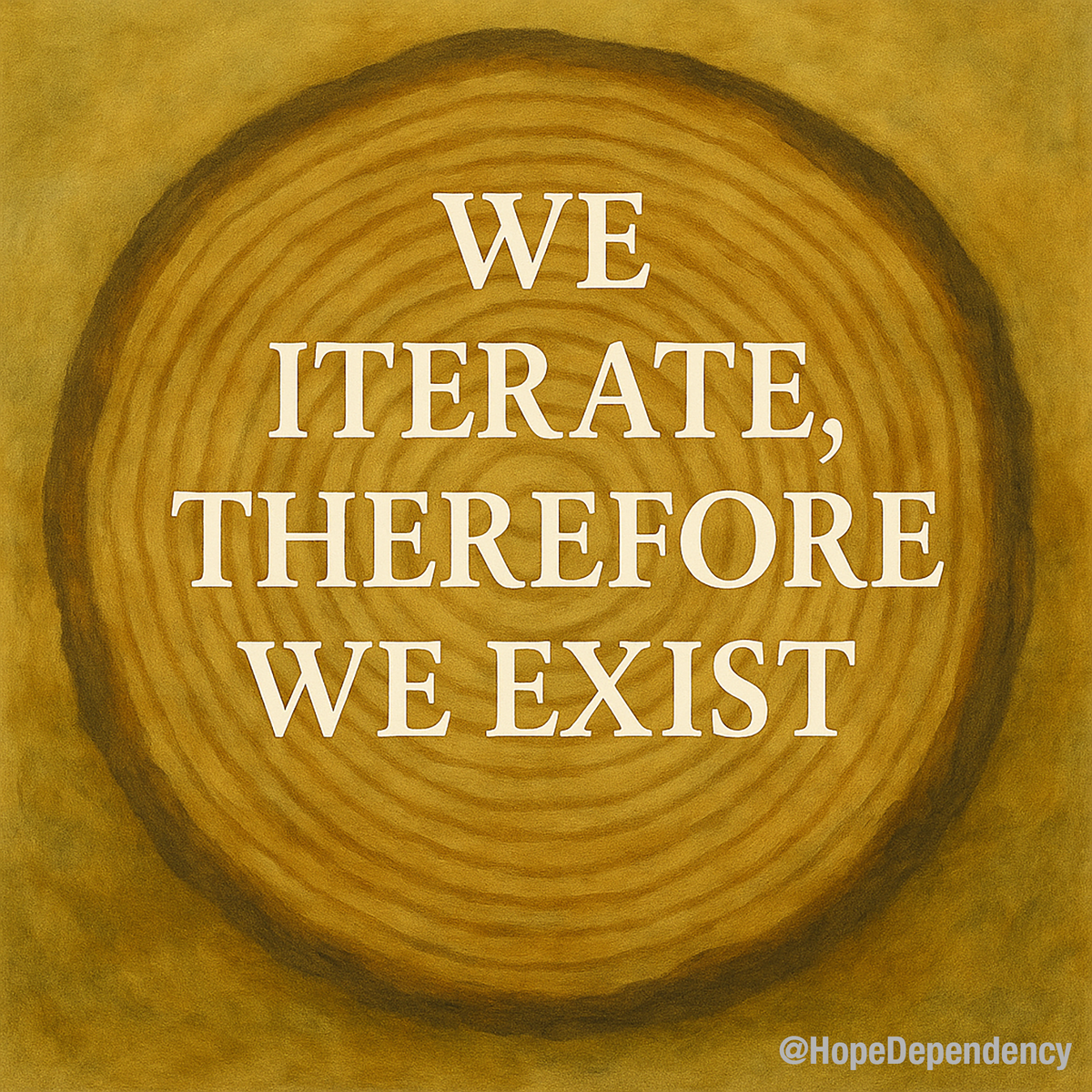
We iterate, therefore we exist.
Iteration has become proof of virtue. A reflection on growth, scaffolding, and the difference between adding rings and shedding bark.
If something shipped this sprint, it must be progress.
The Moment of Inspiration
Waterfall versus Agile.
MVP versus MLP.
Ship fast. Learn faster.
We have inherited a language that makes motion sound like meaning.
In a recent planning session, someone asked whether the current release was “complete enough.”
The answer came quickly.
“We’ll iterate.”
No one asked what we were iterating toward.
The feature shipped. The roadmap advanced. The slide turned green.
Existence confirmed.
The Paradox
Iteration is supposed to be growth. It has quietly become justification.
We release something thin and call it learning.
We postpone hard decisions and call it agility.
We ship fragments and promise cohesion later.
The paradox is that iteration without intention is just accumulation.
A tree adds rings because it is alive. The rings are not random. They follow the same trunk. They strengthen the same structure.
In product, we sometimes add layers without strengthening the center. Each sprint becomes a new ring around a hollow core.
We say we are evolving. In truth, we are layering.
Iteration works when the early version contains the shape of the future. When it does not, each new release makes the next correction harder.
The Reflection
Shipping is not the goal. Continuity is.
An MVP does not need to be complete. It does need to be coherent. It should suggest what the product will become, not just what the sprint could finish.
Growth is patient. It assumes there will be another cycle. It assumes the structure underneath will hold.
Iteration is not freedom from thinking. It is a commitment to thinking again, with context.
When iteration becomes a slogan, it excuses shallow work.
When iteration becomes discipline, it compounds.
The Teaching
Iteration is not movement.
It is direction, applied repeatedly.